What the panels actually debated
Last month, Launchpad Build AI hosted an exclusive summit in Edinburgh, Scotland, to discuss the future of AI and robotics. We were privileged to have the event covered in a series of articles by leading publication, Newsweek. In this post, the third of four, we look back at the event and showcase some of the insights it revealed.
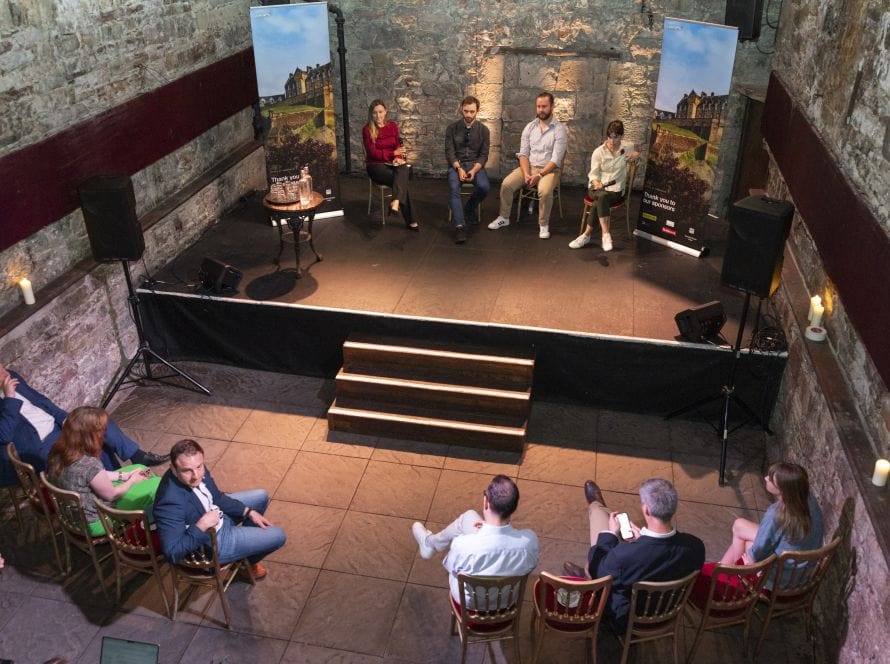
Once the pipers packed up and Launchpad Build AI’s World of Tomorrow summit moved from Edinburgh Castle into the working panel sessions, the mood shifted from ceremony to hard questions.
Held inside The Caves (a converted stables on Niddry Street in the heart of the Old Town) the panels kept circling one tension: as Newsweek’s Megan Carnegie put it in the third of her articles about the Summit “software is racing ahead, while factories and supply chains still move too slowly.”
Chorus.ai founder Roy Raanani named the bottleneck directly, telling the Summit that AI is in such demand, that “the bottleneck to growth is in the upstream supply chain given the time needed to build factories and components.”
In a market that rewards speed, he argued that long-term supply relationships with infrastructure providers have become one of the few real advantages available to startups working in the physical world.
Simulation emerged as a recurring answer to that speed problem. Our CEO Jon Quick noted that digital twins let teams “tweak, simulate and refine in a much tighter loop” before ever touching physical hardware, though panelists were candid that the models behind these simulations remain imperfect and still under-trusted.
That gap between capability and trust ran through the day’s toughest conversations. Orrick, Herrington & Sutcliffe partner Alex Sobolev flagged the liability problem at the center of AI’s move into physical systems: “When AI goes wrong, there’s huge uncertainty around who is responsible, especially when causation is difficult to establish in a black-box system with no clear explanation for how a decision was reached.”
Speakers repeatedly returned to autonomous vehicles as the cautionary tale for what happens when promise outpaces proof.
According to our own Vice President of Artificial Intelligence, Yannis Georgas, Europe is firmly in the driving seat when it comes to regulation. Newsweek summarized his point: “AI models controlling physical machinery are categorized as ‘High-Risk’…meaning systems shouldn’t be pushed into production without robust simulation and strong data foundations to verify safety first.”
A lot remains to be worked out for AI’s potential in the manufacturing industry to be fully unleashed, but we believe the discussions we hosted in Edinburgh marked a meaningful milestone along the way.
You can read all the articles in the Newsweek series about Launchpad Build AI’s Summit here:
https://www.newsweek.com/world-of-tomorrow-ai-factory-floor-12106904
https://www.newsweek.com/world-of-tomorrow-scotland-ai-robotics-12116700
https://www.newsweek.com/ai-race-models-manufacturing-world-of-tomorrow-12122020
https://www.newsweek.com/ai-industrial-power-struggles-world-of-tomorrow-12146543